
The Truth About Hair Bundle Prices: Virgin vs. Fake Human Hair (A Manufacturer’s Guide) (Part 1)
PS: This is Part 1 of the “Uncovering Human Hair Bundle Prices” series. This 6-part series will guide you through the entire inside story of hair bundles—from raw materials and craftsmanship to purity levels and purchasing advice. If this is your first time here, we highly recommend starting with this article
Whether you are a salon owner, an independent stylist, or a dropshipper searching for a reliable raw human hair vendor, this guide will save you from costly sourcing disasters.
When you want to buy human hair bundles and look online, almost everything is labeled “100% Human Hair.” However, some sell for just a few dozen dollars a bundle, while others cost hundreds or even thousands. The pictures all look like the exact same hair — so why is the price gap so massive?
Let’s start with the conclusion: In the hair industry, you get exactly what you pay for.
There is a saying in the industry: “30% craftsmanship, 70% sourcing.” This means that 70% of a hair bundle’s quality is already determined the moment the raw material is collected. In this article, I will tear down the entire process—from raw material to craftsmanship to purity—so you can understand the truth: the difference between one “human hair” bundle and another spans an entire supply chain.
1. The Foundation of Raw Materials: The Value of Your Hair Bundle Is Decided While It’s Still on a Head
In the cost breakdown of human hair bundles, raw materials account for the absolute majority. They might all look like bundles of black hair, but they can be fundamentally different. I categorize human hair raw materials into three grades. Once you understand them, you will see why some bundles are highly sought after at premium prices, while cheaper ones are left untouched.
(1) Virgin Hair / Cuticle-Aligned Remy Hair —The “Noble Bloodline” of Hair Bundles
Virgin Hair (also known in the trade as Cuticle-Aligned Remy Hair) refers to natural, unpermed, and undyed long braids cut directly from a human donor.
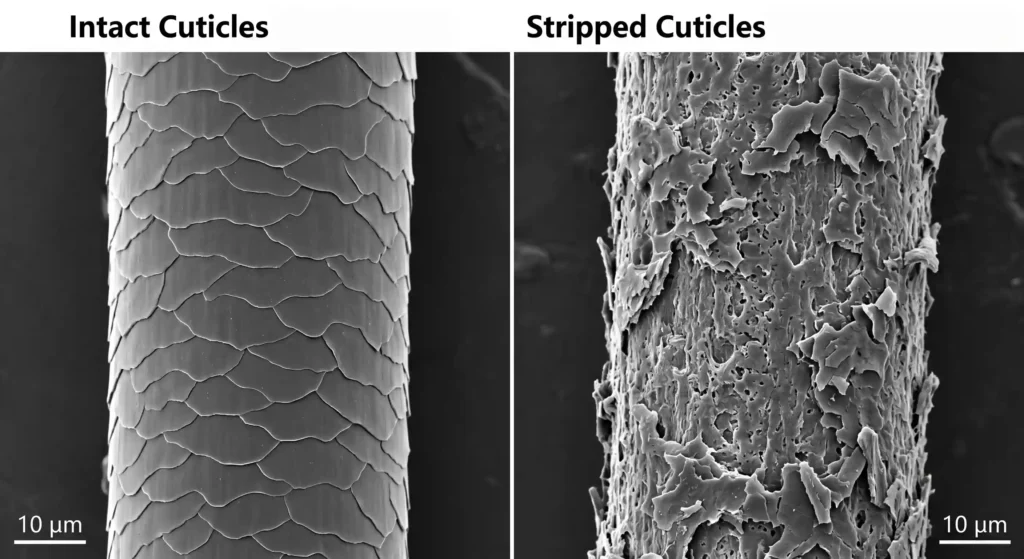
Its sourcing is highly specific —it primarily comes from young girls in rural or remote areas who have grown their hair for years without any chemical processing. The donors usually lead simple lifestyles, meaning the hair has never suffered the damage of perming, dyeing, bleaching, or chemical straightening. The hair cuticles remain completely intact, overlapping tightly like fish scales, and face the exact same direction.
When this hair is made into bundles, it has several irreplaceable advantages:
No Acid Bath Required: Because the cuticles naturally face the same direction, the hair only needs to be manually sorted and combed. There is absolutely no need for harsh chemical acids to force the hair straight. This means the internal structure of the hair strand remains intact, the proteins are not lost, and with proper care, the lifespan of these bundles can easily exceed 3 years.
Gets Smoother with Wear: This is the most fascinating trait of high-quality virgin hair. While low-grade hair gets frizzier over time, virgin hair actually gets smoother. Because the cuticles are intact, they can naturally blend with your scalp’s natural oils (or your hair care products), becoming more lustrous the longer you wear it.
Endless Styling Options: Virgin hair bundles can be curled, straightened, bleached, and dyed to any color you desire. This premium foundation is exactly why top-tier direct hair factories insist on using raw hair to craft high-end textures like Body Wave and Deep Wave, ensuring flawless results even for full, 200% density units.
So why is virgin hair so expensive? Because the resource is extremely scarce. Fewer and fewer women are growing out long braids. A high-quality braid over 50cm and weighing over 100 grams commands a very high raw material cost at the source, and prices are continually rising. The price of one kilogram of premium virgin hair raw material is typically several times— or even over ten times — the price of fallen hair. Almost all premium hair bundles you see on the market priced in the thousands are made from virgin hair bases, without exception.
(2) Fallen Hair (Non-Remy)—Same Appearance, Completely Different Lifespan
Fallen hair (also known as Non-Remy or “floor hair”) is the industry term for low-grade hair. Its origins might make you slightly uncomfortable: shed hair pulled from combs, clumps of hair swept from barbershop floors, or hair gathered from domestic waste.
What is the common trait of all this hair? The cuticle directions are completely chaotic. Imagine hair swept up from the floo r— some roots point up, some ends point up, some are tangled into balls. Thousands of hair cuticles are mixed together with absolutely no uniform direction.
What happens if this messy hair is directly made into bundles? It would be impossible to comb through and would feel like a steel wire sponge. So why do these bundles look smooth on the market? The answer lies in two words: Acid Bath.
Why does my human hair tangle and shed? This is the complaint dropshippers face when they unknowingly partner with bad hair vendors. When the temporary silicone “varnish” fades after a few washes, you experience the classic death of a low-grade bundle…
An “acid bath” involves soaking the hair in a strongly acidic chemical solution to corrosively strip away a layer of the cuticles, followed by high-heat straightening. After this process, the cuticles on the hair surface are severely damaged, with some peeling off entirely, exposing the porous cortex.
This is like taking a termite-hollowed piece of wood and coating it in clear varnish. When you first buy it, it looks shiny and feels smooth. But after two or three washes, the silicone “varnish” fades, and the hair strands begin to frantically absorb and lose moisture. Thus, you experience the classic death of a low-grade bundle: it swells, dries out, gets frizzy, mats up, and looks like it exploded.
Another fatal flaw of this hair is its extremely short lifespan. While a good virgin hair bundle lasts over two years, chemically processed non-remy hair usually degrades irreversibly within 3 to 6 months. Do the math: the money spent replacing three cheap bundles is enough to buy one premium virgin hair bundle, but you suffer three times the frustration.
(3) Colored/Treated Hair —Defectives Hidden by “Secondary Processing”
A grade even lower than fallen hair is Colored or Treated Hair, which refers to collected hair that was already dyed or permed by the original owner.
This type of hair has already “survived devastation.” Some of it is dyed black, some bleached blonde, some permed curly. Upon collection, the colors are a mess —reddish, yellowish, half black and half blonde.
To make it look uniform, factories subject it to heavy bleaching and dyeing: stripping the original color first, then dyeing it universally black or a target color. A single strand of hair endures a triple torture of “original perm/dye→bleach→redye,” practically destroying the hair quality completely.
Bundles made from this hair easily expose two major defects:
- Fading to Red: After a month of wear, the bundles start showing a bizarre reddish-brown tint in the sunlight. This happens because the black dye washes out, revealing the damaged, bleached base color.
- Severe Breakage: Comb it once, and your shoulders are covered in broken hair fragments. The inside of the hair strand has turned to powder, breaking at the slightest pull.
The only advantage of this hair is that it is cheap. The cost might be one-tenth that of virgin hair. Therefore, many ridiculously underpriced “human hair bundles” are essentially combinations of treated hair and fallen hair.
To sum it up: Virgin hair, fallen hair, and treated hair are all legally called “human hair,” but their costs differ by more than 10 times. Whether the bundle you buy is a “young girl’s braid” or “barbershop floor sweepings” is decided the moment the hair leaves the human body. This is the root cause of the massive price disparity in human hair bundles —the raw material foundation is the lifeblood of the hair bundle.
| Feature | Virgin Hair (Cuticle-Aligned) | Fallen Hair (Non-Remy) | Treated/Colored Hair |
| Raw Material Source | Cut directly from single donors (Braids) | Floor sweeps, combs, domestic waste | Recycled permed/dyed hair |
| Cuticle Status | 100% Intact, facing the same direction | Scrambled and stripped (Acid Bath) | Severely damaged or destroyed |
| Chemical Processing | None (Raw / Unprocessed) | Heavy acid bath & silicone coating | Heavy bleaching & redyeing |
| Lifespan | 2-3+ Years (Gets smoother with wear) | 3-6 Months (Tangles quickly) | 1-2 Months (Fades and breaks) |
| Bleach/Dye Ability | Can bleach to #613 or lighter easily | Cannot be bleached safely | Will break or melt if bleached again |
| Best For Who | High-end salons, premium dropshippers | Low-budget fast fashion | Avoid for business reputation |